Why MLSecOps exists
Machine learning systems inherit conventional software and cloud risks, but they also introduce assets and behaviors that security programs were not designed to govern. Training data can be poisoned. Models can memorize sensitive records or be packaged in formats that execute code when loaded. Repeated black-box queries can let an attacker train a functional surrogate without recovering the original weights. LLM applications can follow malicious instructions retrieved from external content. Agents can convert a model mistake into an action against a real system.
MLSecOps makes these risks part of normal engineering operations. It connects security decisions to the teams that collect data, train models, package artifacts, deploy endpoints, operate AI applications, and respond to incidents. The objective is not a one-time model audit. The objective is a repeatable control system that produces evidence before release and remains effective as data, models, dependencies, and attacker behavior change.
The MLSecOps lifecycle
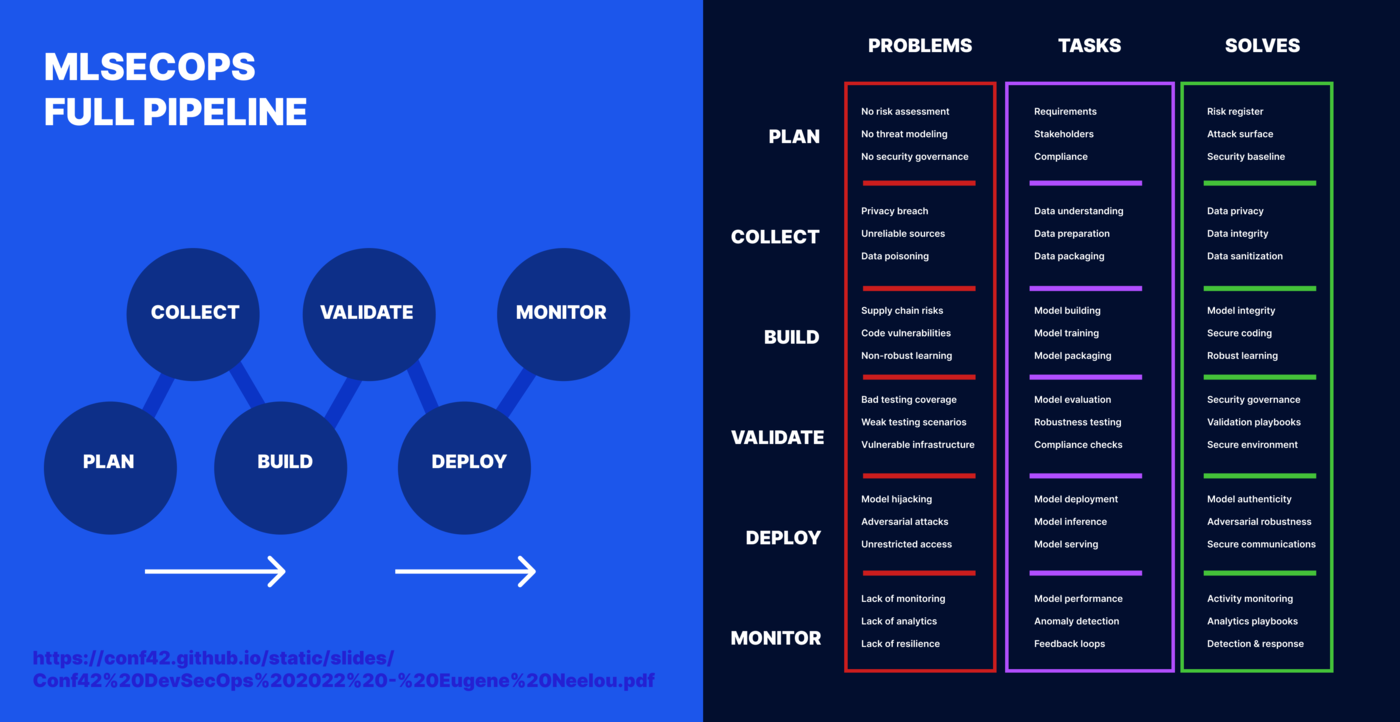
An MLSecOps lifecycle begins before model training and continues after deployment. Each phase has a distinct security question and an accountable owner.
- Discover and classify. Inventory datasets, models, prompts, tools, registries, pipelines, endpoints, owners, and external dependencies. Classify sensitive data and high-impact decisions.
- Threat-model. Define attackers, trust boundaries, abuse cases, model access, data flows, tool permissions, and the consequences of failure. Convert those scenarios into testable requirements.
- Build securely. Separate training and inference identities, restrict data and service access, record dataset lineage and labeling provenance, test for poisoning indicators and distribution anomalies, review training and ingestion code for unsafe deserialization, pin dependencies, protect secrets, and record reproducible provenance for every release candidate.
- Test and assure. Scan artifacts, evaluate adversarial robustness, test privacy leakage, red-team LLM behavior, validate guardrails, and document accepted residual risk.
- Release with evidence. Sign artifacts, enforce deployment policy, attach model and data documentation, record approvals, and preserve a rollback path.
- Monitor and respond. Observe abuse, drift, anomalous access, policy failures, and data exposure. Maintain incident playbooks that can disable tools, revoke credentials, isolate models, and notify affected owners.
MLSecOps, DevSecOps, and AISecOps
DevSecOps integrates security into software delivery. It protects source code, dependencies, build systems, infrastructure, identities, and production services. MLSecOps retains those controls and adds protections for data, training, model artifacts, inference behavior, privacy, and adversarial manipulation. A secure model still depends on secure software and infrastructure, so MLSecOps extends DevSecOps rather than replacing it.
AISecOps is used less consistently. Some teams use it as a broad label for securing AI systems; others use it for applying AI to security operations. MLSecOps is narrower and operationally precise: it focuses on security throughout machine learning and MLOps lifecycles, including LLM and agent systems. See the full MLSecOps versus DevSecOps comparison for ownership and control examples.
Core tool categories
No single product provides MLSecOps. A practical program combines controls that address different assets and failure modes.
LLM Security and Red Teaming
Test prompts, model behavior, guardrails, and application controls against abuse.
Model Scanning and Validation
Inspect model files, notebooks, code, and behavior before release or deployment.
Adversarial Machine Learning
Evaluate evasion, poisoning, extraction, inversion, and model robustness.
AI Supply-Chain Security
Protect model provenance, artifacts, dependencies, signing, and delivery pipelines.
AI Agent and MCP Security
Secure agent tools, memory, identity, permissions, sandboxes, and MCP servers.
Privacy-Preserving Machine Learning
Reduce sensitive-data exposure and test privacy leakage in ML systems.
How to begin
Begin with one important AI service instead of a company-wide tooling purchase. Map its data, model, prompt, dependency, and tool-call paths. Identify the two or three failures with the greatest business or user impact. Add controls that produce reviewable evidence, assign an owner for every unresolved risk, and rehearse one containment scenario. Repeat the process as a release gate, then automate stable checks in the training and deployment pipeline.
The MLSecOps tools and resources directory organizes the community catalog by security problem. The MLSecOps FAQ answers implementation questions, while the GitHub repository remains the canonical place to evaluate and contribute resources. For a longer narrative on why the discipline emerged, read What is MLSecOps? on The MLSecOps Hacker, the newsletter written by this catalog's maintainer.
Primary references
This operating model synthesizes established security guidance rather than defining a new standard. Use the NIST AI Risk Management Framework for governance and lifecycle outcomes, MITRE ATLAS and NIST AI 100-2 for adversarial-ML terminology, the OWASP Top 10 for LLM Applications for generative-AI risks, and SLSA with Sigstore for software and artifact provenance controls. Apply each source within its stated scope; none independently establishes that an ML system is secure.
Frequently asked questions
What does MLSecOps stand for?
MLSecOps stands for Machine Learning Security Operations. It applies security engineering, testing, supply-chain controls, monitoring, and incident response across the machine-learning lifecycle.
How is MLSecOps different from MLOps?
MLOps makes model delivery reliable and repeatable. MLSecOps adds explicit protection against adversarial attacks, unsafe artifacts, privacy leakage, model theft, compromised pipelines, and abuse after deployment.
Is LLM security part of MLSecOps?
Yes. MLSecOps covers LLM applications, including prompt injection, jailbreaks, sensitive-data exposure, RAG poisoning, insecure tool use, guardrail testing, and AI agent security.
Who owns MLSecOps?
MLSecOps is a shared operating responsibility. Security engineers define controls and testing; ML researchers and engineers secure training and model behavior; data engineers manage data access, quality, and lineage; platform teams protect pipelines and infrastructure; and product owners make risk-acceptance and response decisions.
Where should a team start with MLSecOps?
Start with an inventory of models, data, pipelines, tools, and external dependencies. Threat-model the highest-impact system, add artifact and access controls, establish repeatable security tests, and define monitoring and incident ownership before scaling the program.